There is an approach to looking at contamination detection called ALARM which stands for "As Low As Reasonably Manageable". The ALARM principle means reducing the risk of contamination to a level that is as low as it can be managed. This is achieved by balancing factors such as (technical) feasibility, regulatory requirements and budget.
ALARM is based on the principle of ALARA, meaning "As Low As Reasonably Achievable", which has long been associated with radiation and x-ray safety. At its core, it reflects a disciplined approach to risk reduction. Exposure should not simply meet a defined limit but should be reduced as far as reasonably possible.
This thinking can also be applied within food manufacturing, specifically in exposure to contamination detection and foreign material control. In an area where regulatory thresholds are often inconsistent or unclear, it provides manufacturers with a structured framework for decision making.
Moving beyond legacy guidance
Unlike many areas of food safety, there is no globally harmonised standard that defines the size at which foreign bodies must be detected. Contamination detection systems can be validated and their performance proven, but there has historically been little structure around defining the lowest acceptable detection capability.
Many organisations reference 7mm as a detection benchmark as recommended by the U.S. Food and Drug Administration (FDA) Compliance Policy Guide Section 555.4251. However, the potential threat to injure is dependent on the material type and shape of the contaminant below 7mm, for example a shard of glass or hard plastic splinter. By adopting the ALARM principle, the manufacturer would reduce the risk by detecting the lowest millimetre possible according to what is technically feasible - and within budget.
ALARM can be achieved by working closely together with an inspection technology provider who would assess the manufacturer's requirements, the contaminant risks, the Critical Control Point(s), and budget. The result is an environment where manufacturers balance feasibility, budget and risk without a consistent regulatory benchmark.
Applying ALARM to contaminant size
This is where the ALARM approach provides clarity. Instead of asking what minimum detection level is required, manufacturers ask what is the smallest contaminant that can be reliably detected under real production conditions.
Achieving this requires more than selecting inspection technology. It demands a fully validated system that considers environmental stability, vibration control, conveyor condition, aperture size, reject mechanisms and surrounding physical influences. It also should include product conditions such as temperature, moisture percentage and packaging materials.
Validation should take place prior to production using calibrated test pieces that represent the smallest target contaminants. Importantly, testing should challenge the system under least sensitive operating conditions rather than ideal scenarios.
Revalidation is equally important. Any significant change should trigger reassessment. This includes software updates, product reformulation or shifts in line configuration.
Product characteristics also influence detection sensitivity. Frozen product, for example, can produce less product effect than chilled product. Inspecting a hamburger after freezing may therefore deliver improved detection performance compared to earlier stages.
Placement across the production line
Detection capability alone does not define risk control. Equipment placement plays an equally important role. Inspection is often positioned at the end of the line as a single critical control point. While this may identify contaminated finished goods, it can also create avoidable waste. If a contaminant is detected within a sealed case of products, the entire case may require rework or disposal.
Earlier intervention changes the outcome. Inspecting raw materials will help to reduce any contamination risk before the product is further processed allowing for easy identification of the root cause, in this case the supplied material. Inspecting in the batching stage will also reduce the contamination risk and allows for easy identification of the source of the contamination. As raw materials are further processed into the product, root cause identification becomes more challenging. In fact, the most challenging location to identify the root cause of the contamination is after the product has been fully processed after packaging at the end of the line, yet this is where a lot of inspections occur.
Under ALARM, contamination detection is considered from the beginning of production through to final product release rather than as a single point solution. This doesn't mean that a food manufacturer would have to install product inspection equipment throughout the entire production line i.e. at goods-in, in-process and end of line but that this decision can be made easier by using the ALARM principle to consider different risk factors.
Challenging real-world conditions
Effective application of ALARM requires systems to be challenged in their weakest operating states. This includes testing at maximum line speeds, varying product orientation and assessing least sensitive detection zones such as the centre of the aperture in metal detection systems. The objective is to detect the smallest size of physical contaminant under genuine production conditions.
Working with experienced inspection technology providers who can physically assess the line environment is critical. Reviewing vibration sources, reject performance and upstream supplier controls enables manufacturers to identify both preventative and corrective actions.
From compliance to risk reduction
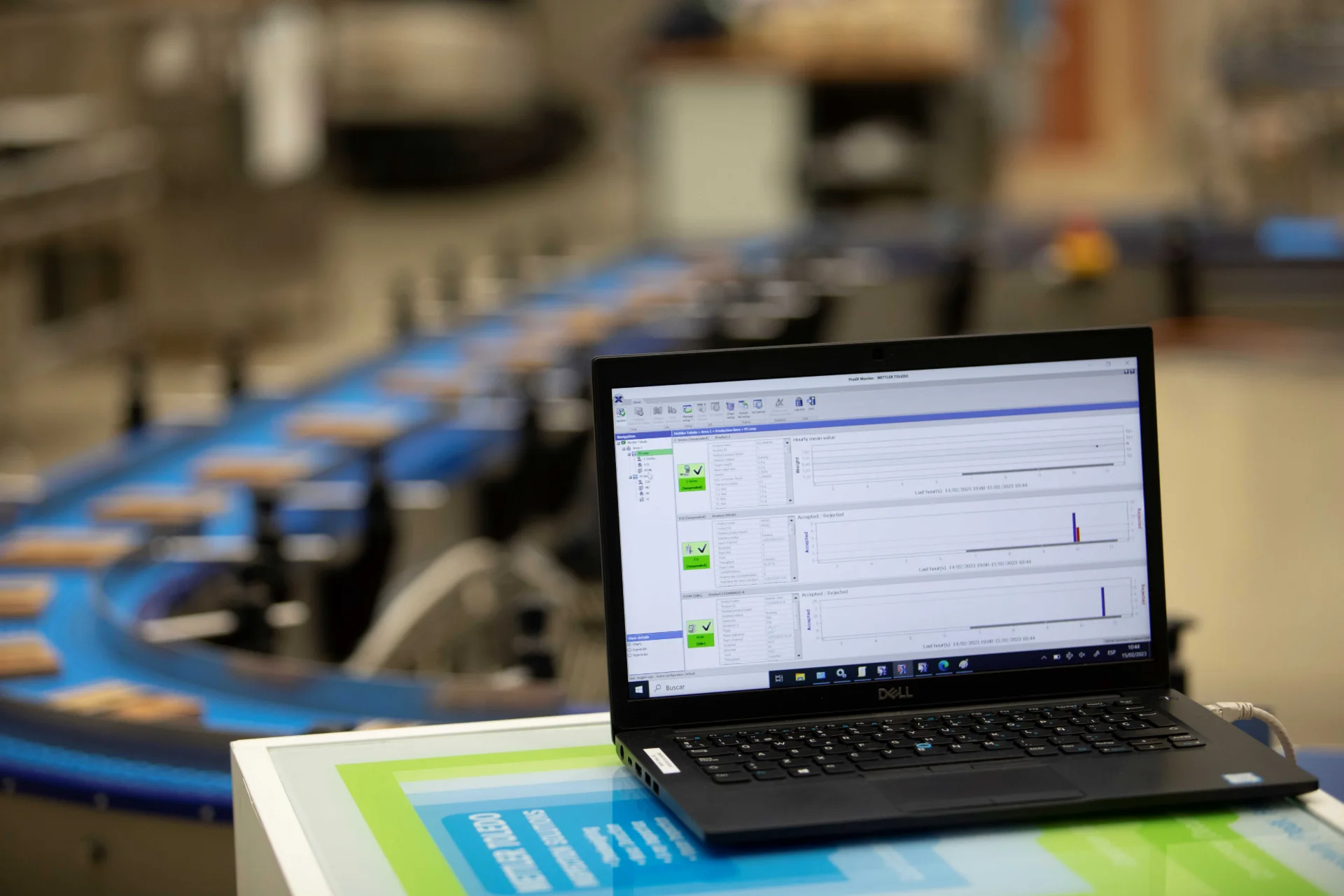
Digital quality management platforms such as ProdX™ from Mettler Toledo can play an important role in supporting ALARM-driven validation strategies. By capturing and centralising testing activity, validation records and inspection performance data, ProdX™ enables manufacturers to maintain a robust digital audit trail, simplify compliance reporting and demonstrate ongoing due diligence with confidence.
Conclusion
Ultimately, applying the ALARM approach to foreign body detection shifts the focus from minimum compliance towards demonstrable risk reduction. In a regulatory environment where clear detection thresholds remain absent, it provides a practical and transparent methodology for reducing contamination risk to the lowest level that is reasonably achievable.
The ALARM principle not only helps to define the contaminant size and placement of inspection technology but can help manufacturers future proof their businesses for upcoming compliance. Exceeding the bare minimum physical contaminant detection thresholds will help place manufacturers far above their rivals when competing for retailer contracts and protect their brand excellence.
To learn more about how Food Safety Compliance can be supported please click here or visit: www.mt.com/pi-food-safety-pr
1 CPG Sec 555.425 Foods, Adulteration Involving hard or Sharp Foreign Objects. The Compliance Policy Guide (CPG) is an official document published by the U.S. Food and Drug Administration (FDA). It communicates the agency's enforcement strategy to internal staff, such as investigators and compliance officers, and to the industries it regulates. CPGs provide uniform instructions on how to approach regulatory issues, offering crucial insight into the FDA's operational priorities and expectations for entities involved with FDA-regulated products.
By Rob Rogers, Senior Advisor Food Safety & Regulation, Mettler Toledo