
Some of the first plans in the €500 million redevelopment of Dublin city’s most prominent site, the 5.5-acre plot stretching from O’Connell Street to Moore Street, have been approved by Dublin City Council.
UK property group Hammerson
last June lodged three applications for a mixed retail, office and
residential scheme on the vast city block formerly known as the Carlton site, parts of which have lain vacant and derelict for more than 40 years.
The
site, which stretches west from O’Connell Street to Moore Street, and
north from Henry Street to Parnell Street, is being developed under six
separate planning applications.
Two
of the first three applications, which focus on Moore Street and Henry
Street, and include residential, hotel, retail, restaurant and cafe and
cultural uses, have now been approved by the council.
In
relation to the third application towards the northern end of Moore
Street at O’Rahilly Parade, the council has asked Hammerson to submit an
amended daylight and sunlight analysis of the effect the development
will have on neighbouring apartments.
However,
the two approved applications are the more substantial, with one
involving the land surrounding the 1916 Rising National Monument
buildings at 14-17 Moore Street. These State-owned buildings are due to
be developed separately as a Rising Commemorative Centre, a project expected to cost at least €16.25 million.
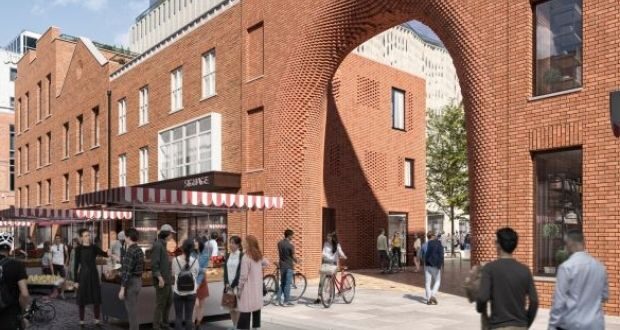
The
application surrounding this site was controversial as it proposed a
large archway beside the national monument which broke up the Moore
Street terrace. Under conditions attached to the grant of permission the
archway must be reduced in scale and its detailing more closely aligned
to 17 Moore Street.
The second approved application, which deals with buildings on Henry Street and the southern end of Moore Street, involved the construction of a nine-storey hotel, and the demolition of two buildings: 38 Henry Street which will be replaced with a passageway and 41 Henry Street, at the corner of Moore Street, would be replaced with a new building.
The Department of Housing had made a submission to
the council opposing the demolition of number 38 Henry Street, saying it
was “unnecessary”. However the council has approved its removal.
While the council has approved Hammerson’s plans they will be appealed to An Bord Pleanála.
James Connolly
Heron, great-grandson of 1916 leader James Connolly said the council’s
decision was “another significant blow to the unique heritage of Dublin
which is increasingly under attack by developers” and “ will not stand
unchallenged”.
Moore Street was in grave danger of being “lost forever in the commercial interest of Hammerson”, he said.
“The
Moore Street Preservation Trust and the Relatives of the 1916 Leaders
repeat our call on the Minister for Housing, Local Government and
Heritage Darragh O’Brien as guardian of our history and heritage to act
urgently and undertake to protect and preserve all 1916 buildings and
the surrounding battlefield site through the issuing of Preservation
Orders,” he said.
“There
is an alternative plan available for the positive development of Moore
Street. It was produced by the Moore Street Preservation Trust and has
been widely welcomed.”
Green Party councillor Donna Cooney, who chairs the Lord Mayor’s Forum on Moore Street, said she would also be appealing the decisions.
“While
some of the issues have been addressed in the conditions, they are
cosmetic in comparison to the extensive demolition,” she said. “The
large archway, while reduced, is still out of keeping with the terrace
and I am concerned about the protection of the rest of the terrace.”
Stephen Troy,
chairperson of the Dublin 1 Business Alliance and owner of Troys’
Butchers on Moore Street, said the council had given Hammerson
permission to “destroy” Moore Street.
“I believe this will go down as the biggest planning mistake in Irish history to date, as let’s not forget that this will lead to the existing 5.5-acre city centre retail core becoming a 15-year building site,” he said
Hammerson was unavailable for comment on Thursday.
The
site was for years known as the Carlton site as originally it just
encompassed the old Carlton cinema, the plot beside it that had been
vacant since 1979, and some backlands between O’Connell Street and Moore
Street.
Hammerson
three years ago decided to scrap the existing 2010 planning permission
for a €1.25 billion enclosed shopping complex on the site which runs
west from O’Connell Street to Moore Street, and north of Henry Street to
Parnell Street.
Instead
it plans a more open scheme which will restore the historic street
pattern, and will include a new east-west pedestrian street between
O’Connell Street and Moore Street, two new civic squares, shops,
offices, apartments, hotels and an underground station for the new
Metrolink rail line.
As part of the next three applications the facade of the old cinema will be restored, though the cinema itself will not be retained in situ. Three protected structures, 42 O’Connell Street – the last remaining Georgian house on the street, O’Connell Hall at the back of No 42, and Conway’s pub, will also be restored.
Source Irish Times