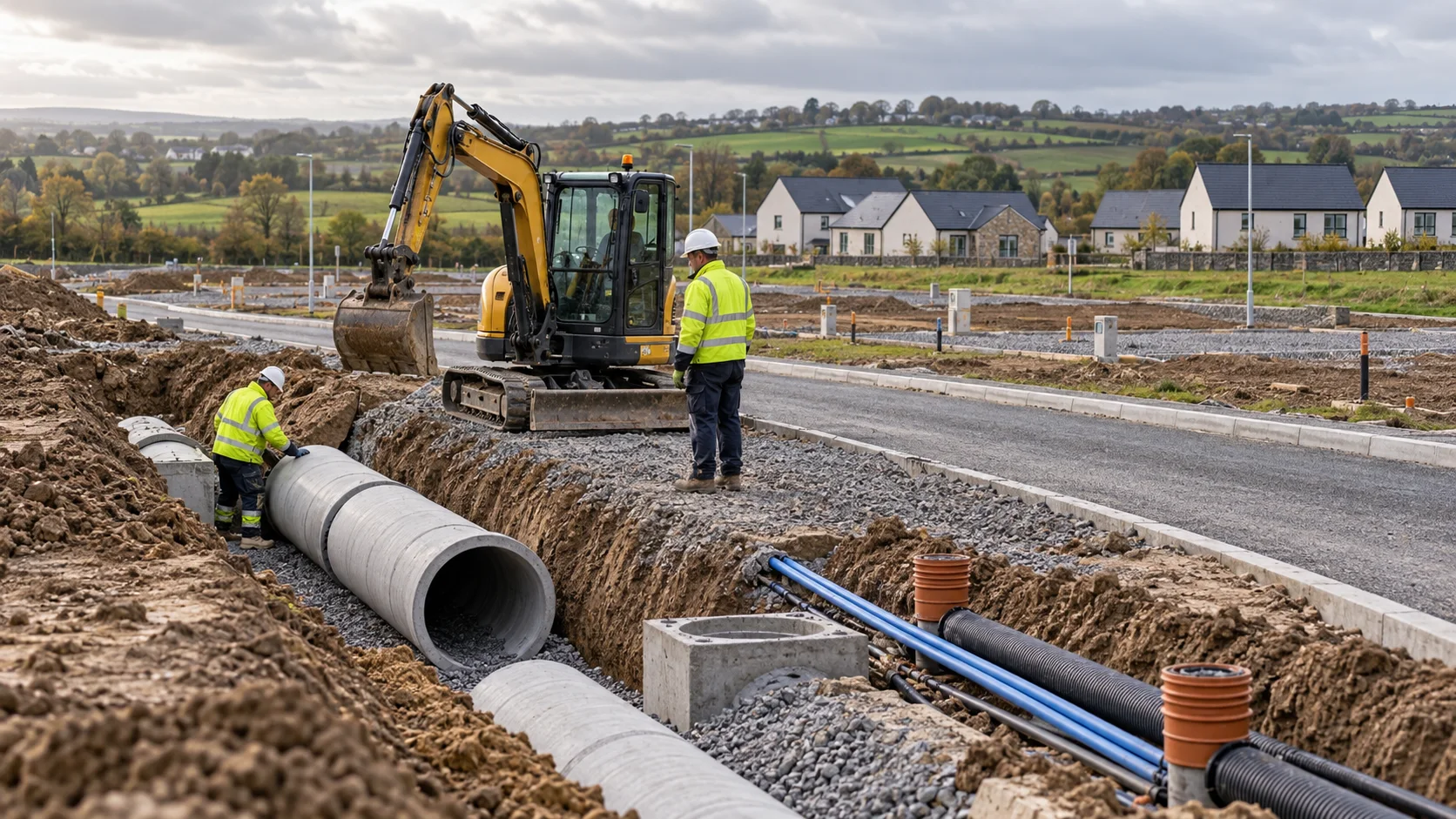
The Government's €1 billion Housing Infrastructure Investment Fund entered a delivery phase during 2026 following the approval of 82 projects in its first round. Information given in the Oireachtas on 1 October said the selected projects could directly enable approximately 86,000 homes and potentially support a further 113,000 through related development capacity. The figures describe housing capacity that infrastructure may unlock, rather than homes already completed or guaranteed for construction. The distinction is central to understanding both the scale of the programme and the challenges of measuring its eventual success.
A housing site may be zoned for residential use but still lack the services needed for building to proceed. Roads, junctions, drainage, water and wastewater connections, electricity infrastructure and other public works can determine whether a development is practical. The fund is designed to address such enabling constraints by financing infrastructure that serves housing sites. In that respect it differs from schemes that directly pay for constructing individual homes or subsidise the price of a finished dwelling.
The first call attracted 138 applications from local authorities and the Land Development Agency. Following assessment, 82 projects were accepted. The Department has said the programme covers a range of interventions, from local works to larger strategic schemes. The selected portfolio therefore cannot be understood as a single construction project with one contract or completion date. It contains projects with different technical risks, local planning contexts and links to other infrastructure networks. Each will need to be tracked against its own milestones.
The Housing Activation Office coordinates the programme and engagement with bodies including Uisce Éireann and ESB Networks. That coordination matters because one infrastructure upgrade can be insufficient if a different service remains constrained. For example, improving road access does not remove a wastewater capacity limitation, and installing a new utility connection does not secure planning consent for homes. The potential value of an enabling investment depends on whether the necessary pieces are delivered in a sequence that allows developers to proceed.
The October parliamentary answer said five funded projects were expected to be completed by the first quarter of 2027. That is an expectation, not evidence of completion. It nevertheless provides a more immediate milestone against which delivery can be assessed. The programme's wider horizon is longer, with housing outcomes depending on subsequent developer activity and market conditions. Public reporting will be more informative if it separates infrastructure work started and completed from serviced sites activated and actual homes constructed.
For contractors and consultants, the fund may generate opportunities in civil engineering, design, utilities, roads, drainage and project management. Procurement arrangements will depend on the relevant delivery body and project. Companies cannot assume that all available funding will translate into immediate tender opportunities: projects must progress through design, approvals, procurement and site mobilisation, and some may require complementary expenditure from other agencies. The programme may therefore influence future construction workloads over several years rather than producing a uniform short-term increase.
The initiative also raises questions about public-investment effectiveness. Enabling infrastructure can provide capacity for more than one development and may have value beyond housing, but projected housing numbers should be scrutinised carefully. Some sites may progress quickly; others may face finance, planning, viability or ownership constraints. Housing demand and commercial decisions can also change. A balanced evaluation will need to ask whether funded infrastructure was delivered as intended, whether bottlenecks were genuinely removed and whether resulting capacity was taken up.
Housing activation is also sensitive to timing. Public works completed substantially before homes are built may still be necessary, but the associated benefits can take longer to appear in output statistics. By contrast, where development is ready to proceed, a small missing connection or road improvement may be the immediate constraint. It is therefore useful to assess the portfolio by the type of barrier removed and the expected sequence of development, rather than ranking projects only by the projected number of homes associated with them. Local authorities may also face constraints relating to design resources, contractor capacity and coordination with private developments. Regular reporting on these practical stages would make it easier to understand why some projects move faster than others. For industry participants, it would also provide a clearer view of which work is progressing towards procurement and construction, as distinct from projects whose funding has been approved but that remain in preparation.
The next stage is implementation and transparent monitoring of the approved portfolio. Progress reports on construction, spending, service capacity and housing activation will help determine whether the first-round assumptions are borne out. The fund is a significant attempt to address one category of barrier to new housing, but it does not remove every obstacle to residential development. The central lesson is that the distance between approved funding and completed homes involves several distinct decisions, delivery steps and organisations.